


This feature documentary explores a phenomenon that blurs life and death to an unprecedented degree. In what Tibetan Buddhists call ‘tukdam’, advanced meditators die in a consciously controlled manner. Though dead according to our biomedical standards, they often stay sitting upright in meditation; remarkably, their bodies remain fresh and lifelike, without signs of decay for days, sometimes weeks after clinical death. Following ground-breaking scientific research into tukdam and taking us into intimate death stories of Tibetan meditators, the film juxtaposes scientific and Tibetan perspectives as it tries to unravel the mystery of ‘tukdam’.
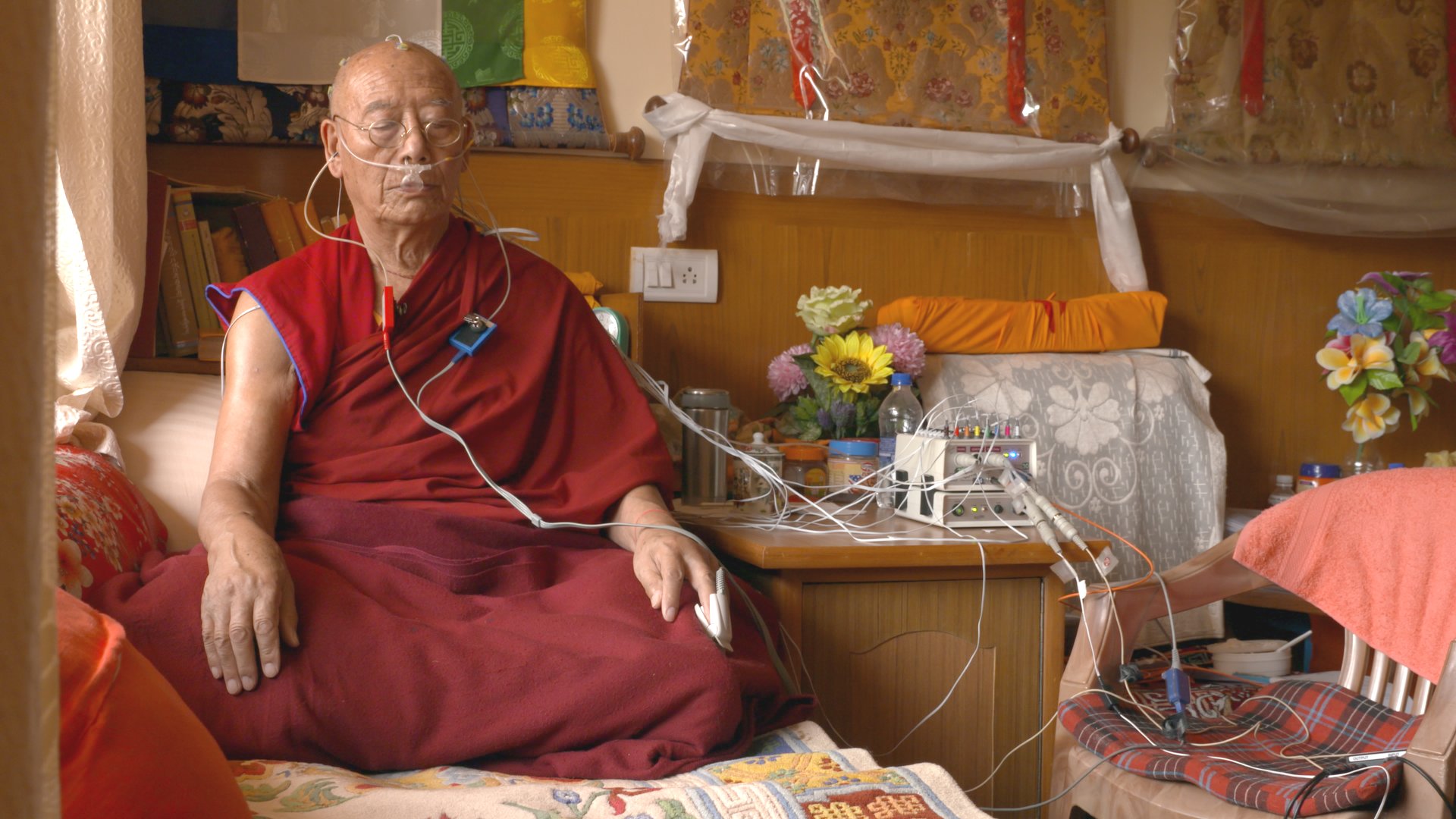
86-year-old monk Tashi Namgyal is an advanced meditator, who, at the request of the Dalai Lama, took part in the scientific Tukdam study as a control subject.
Longer synopsis
Most people think of death as clear-cut, that medical science has it neatly figured out. This film explodes such assumptions through exploration of a phenomenon that blurs life and death. In what Tibetans call tukdam, advanced Buddhist practitioners die in a consciously controlled manner in meditation. Though declared clinically dead, they often stay sitting upright in meditation posture, bodies remaining life-like without signs of decay for days,
sometimes weeks after clinical death. From a Tibetan Buddhist POV, the meditators are not dead yet; consciousness is still present, which is keeping the body from decaying.
The film follows the first ever scientific research project on tukdam, led by leading neuro-scientist Richard Davidson. Supported by the Dalai Lama, the research is carried out among the exiled Tibetan community in India collaborating with local Tibetan medicine doctors. Studying this culturally sensitive phenomenon proves challenging, as scientists struggle to reach tukdam deaths in monasteries and remote Himalayan hermitages.
Counter-balancing the scientific research, the film takes us into intimate death stories of tukdam meditators and Tibetan understandings of death– ideas about consciousness and the mind-body connection that are very different to those of mainstream science. The tukdam of elderly Tibetan lama Tenga Rinpoche in Kathmandu deepens the mystery. Taking us into Tibetan monastic life, this tukdam is also witnessed by U.S. mortician Vanessa Lopez, who embalms the body of Rinpoche after he comes out of his postmortem state.
Unfolding in cinematic dialogue between scientific and Tibetan perspectives, the film unravels our certainties about life and death, and shows how differently death can be construed in different cultural contexts.