

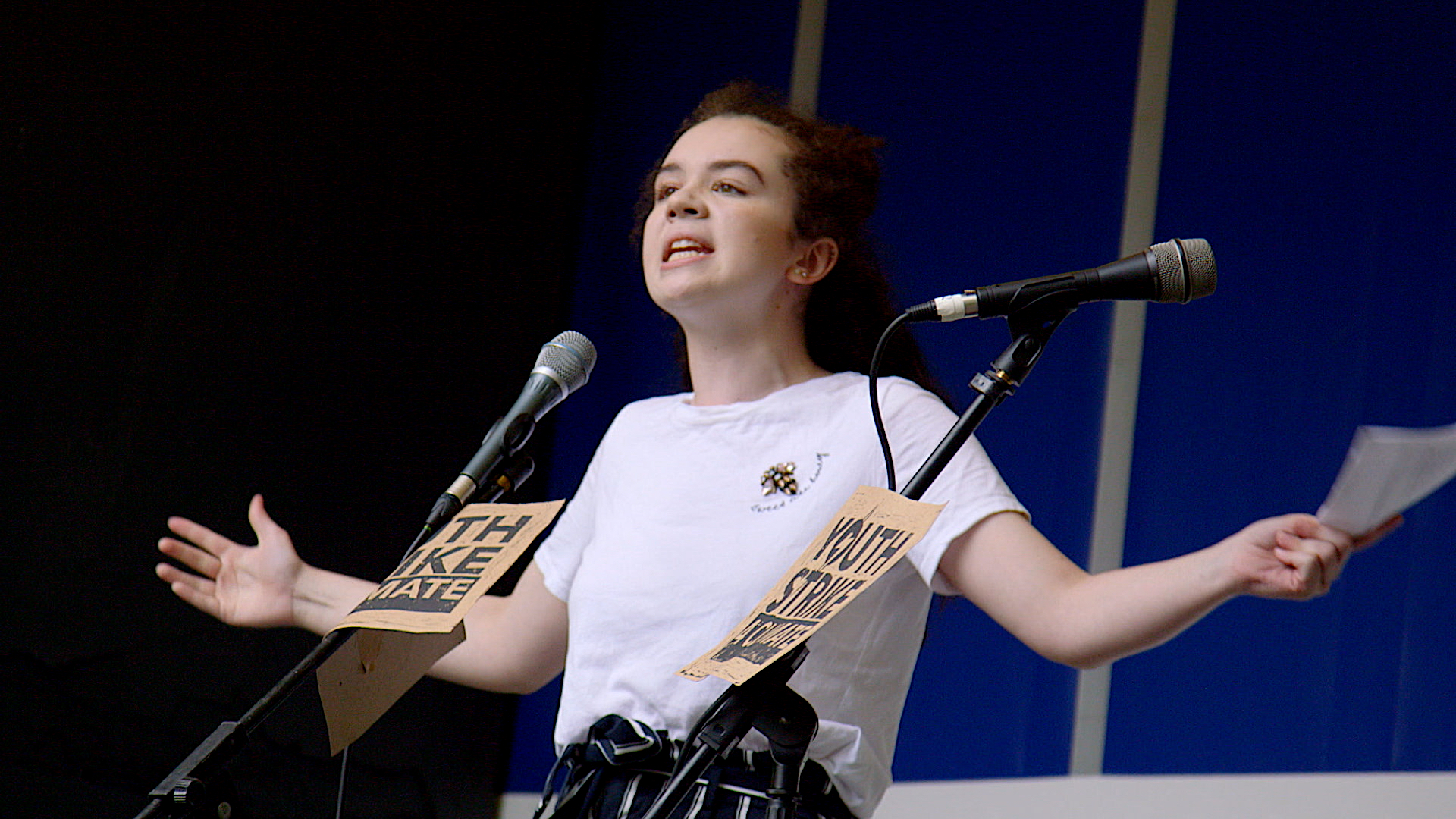


Go to school or save the world? In 2019, kids across the globe went on strike, skipping school on Fridays to stand outside city halls and parliament buildings and demand their governments act on climate change. Galvanised by the original school striker Greta Thunberg, they developed a manifesto, organised marches, made speeches before policymakers, and built the biggest environmental movement in history… only to have it all
come to a sudden halt when the world became gripped by a global pandemic. Now, with their momentum gone and disillusionment setting in, the activists still standing must start over.
Over the course of a year and a half, we follow three of these activists – 16-year-olds Saoi O’Connor, Theo Cullen-Mouze and Beth Doherty – as they lead demonstrations, interrogate politicians, and work alongside Greta Thunberg to create a vision for the youth climate movement, all while juggling school, friends, and a global pandemic.
Growing Up at the End of the World isn’t just about climate change. It’s a deep dive into the lives of three teenagers who have taken on a momentous challenge. We get a sense of who they are and who they want to be. We see their strengths, their weaknesses, and their inspiring hope for a better future.
SAOI Saoi (they/them) wakes up at 5am every Friday. Her mum makes her breakfast at their home in Skibbereen, before her dad drives her to a local bus stop. Instead of going to school, she takes the 237 bus to Cork City two hours away, walks to City Hall, and stands outside for the day holding her now famous sign that reads: “The emperor has no clothes”. It started as a
one-person protest against climate inaction. Now, Saoi is Ireland’s leading youth climate activist. Deciding to take a year off school to focus on activism, she spends her time organising actions, fielding press questions and corresponding daily with activists all over the world through WhatsApp and Skype.
THEO
Theo plays classical guitar, reads Bertrand Russell for fun, and helps out on his family’s organic farm on a remote island off the west coast of Ireland. Growing up on Clare Island, he has long been aware of climate change. He and his family have noticed changes in recent years, like the worsening and increased frequency of storms, the dwindling of insect populations, and certain foods growing better or worse. Changes in the weather have meant
increases in electricity outages and ferry cancellations. Theo knows the exact moment he decided to get involved in the school strikes: seeing Greta Thunberg’s speech at the UN COP24 climate talks in December 2018 on YouTube. Moved by her simple, sincere words and calm
conviction, he went on strike with his younger sister Maude. After months of committed activism, he becomes disillusioned with the movement during the pandemic; digital strikes seem ineffectual and the movement’s consensus form of governance becomes frustrating. But after a
break, he is ready to rejoin and reboot the movement.
BETH
Beth’s (she/her) activism began with Ireland’s abortion referendum campaign when she was 14. Her parents thought her too young to attend the pro-choice marches, but she wore the buttons and taped campaign posters to her bright pink bedroom walls at her home in
Balbriggan, Dublin. Two years later, she prepares for the biggest environmental protest march in history by painting “Planet > Politics” on a piece of cardboard in green paint: “This is the first protest poster I’ve ever made”. Along with Theo, Saoi and a number of other Irish youth
strikers, she travels to Lausanne, Switzerland for a Fridays For Future conference where she works alongside activists, including Greta, to help develop the movement’s demands – a difficult and contentious task. Beth stays hopeful throughout the pandemic and throws herself
into a sort of post-Covid-19 taskforce responsible for the movement’s survival.